
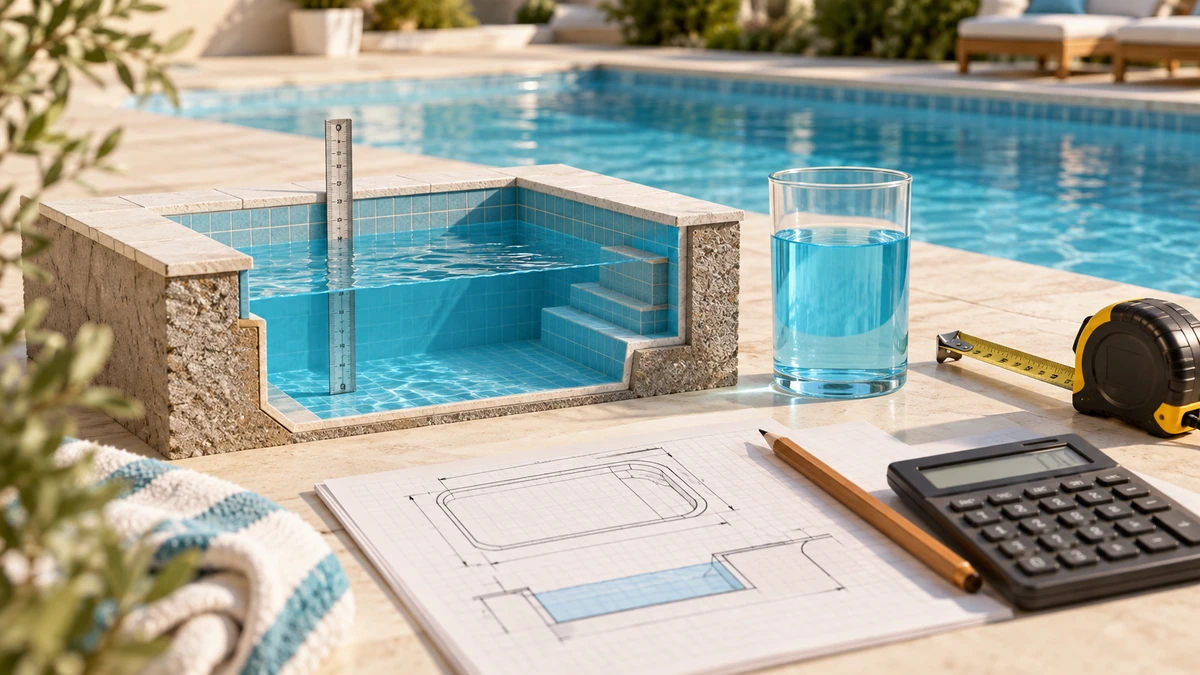
In this guide
To estimate how much water a pool holds, measure the area at the waterline and multiply it by a representative water depth. Then convert the cubic volume to U.S. gallons or liters. The shape and depth measurements matter more than carrying the conversion factor to extra decimal places.
A volume estimate can help you compare filling plans, check a contractor’s capacity figure, or supply an input to a pool chemical calculator. Use the pool’s normal operating water level whenever you want a figure you can reuse. If the water level is unusually low, make a note of that before recording your measurements.
Steps at a glance
- Measure the inside dimensions at the waterline and record the water depth in a consistent unit.
- Choose a shape and divide changes in slope or outline into sections you can calculate separately.
- Multiply each section’s water-surface area by its average depth and add the cubic volumes.
- Convert the cubic volume to U.S. gallons or liters and check it against a reliable capacity record if available.
Measure from the waterline
Start with a sketch of the pool as seen from above. For a rectangle, record the inside length and inside width at the waterline. For a circle, measure across the center from one inside edge to the opposite edge. That full distance is the diameter. Divide it by two only if you are doing the radius-based formula by hand.
Measure the vertical distance from the water surface to the pool floor. The number on a shell drawing may describe wall height, and a pool’s advertised dimensions may include the rim. Check what those figures refer to before entering them. For a vinyl or fiberglass pool with rounded corners, note where your sketch simplifies the actual outline.
Write the unit beside every measurement. If one depth is written as 4 feet 6 inches, enter 4.5 feet in a decimal-feet field. Typing 4.6 feet represents a different measurement. When using meters, convert centimeters to decimal meters first.
Choose the formula that fits the pool
Measure the shallow and deep ends of a rectangular pool with a floor that slopes evenly from one end to the other. Add the two depths and divide by two. If part of the floor is flat and another part slopes, split the footprint at the change in slope. Work out each section using its own length and average depth, then add the section volumes.
For a pool with an attached spa or another separate water area, decide which water you are estimating before adding sections. Keep an independent spa out of the pool total if its plumbing and treatment are separate. For an irregular pool, sketch smaller shapes with boundaries that meet without overlapping. The sum is only as good as that sketch.
| Layout | Formula | Depth to use |
|---|---|---|
| Flat rectangle | Length × width × depth | Measured water depth |
| Rectangle with an even slope | Length × width × average depth | (Shallow + deep) ÷ 2 |
| Flat round pool | π × radius² × depth | Measured water depth |
| Flat and sloped sections | Sum the volume of each section | Average depth within each section |
Work through a rectangular example
Suppose the waterline is 30 feet long and 15 feet wide. The floor slopes evenly from a 3-foot shallow end to a 7-foot deep end. The average depth is (3 + 7) ÷ 2 = 5 feet. The water surface is 30 × 15 = 450 square feet. Multiplying by 5 feet gives 2,250 cubic feet.
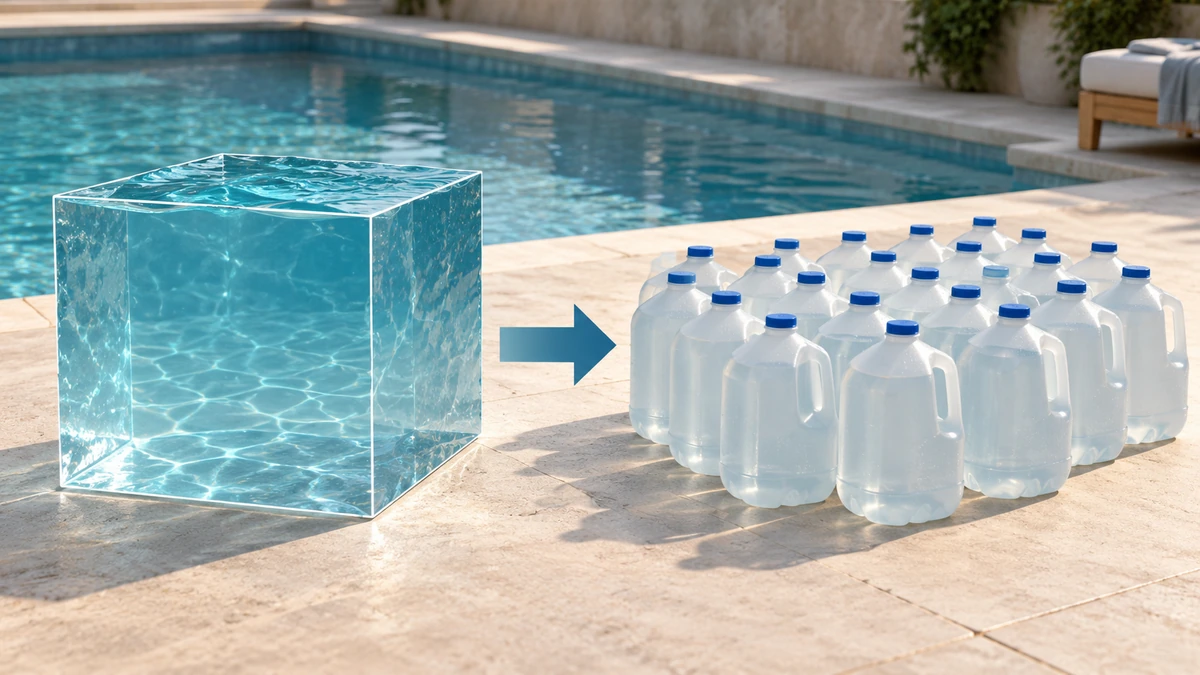
Multiply 2,250 by about 7.48 to get about 16,830 U.S. gallons. The same volume is about 63,700 liters. The Building America Solution Center uses the rounded gallon factor in its pool-pump sizing guidance. In a metric calculation, multiply cubic meters by 1,000 to get liters.
U.S. Department of Energy Building America Solution CenterNational Institute of Standards and TechnologyTo see how the estimate responds to a measurement error, change only the average depth to 4.5 feet. The volume falls by one tenth because the surface area stayed the same. If the calculator and your hand estimate disagree by much more than rounding would explain, check the depth entry, the shape setting, and whether the tool expected diameter or radius.
Check the estimate against the actual fill
A long bench or tanning ledge can displace enough water to matter. Sketch the ledge as its own shallow section if you can measure its footprint and depth. Keep the areas separate so you do not count the water above the ledge and the full depth beneath it. If the pool has a deep hopper with angled sides, record that as a source of uncertainty.
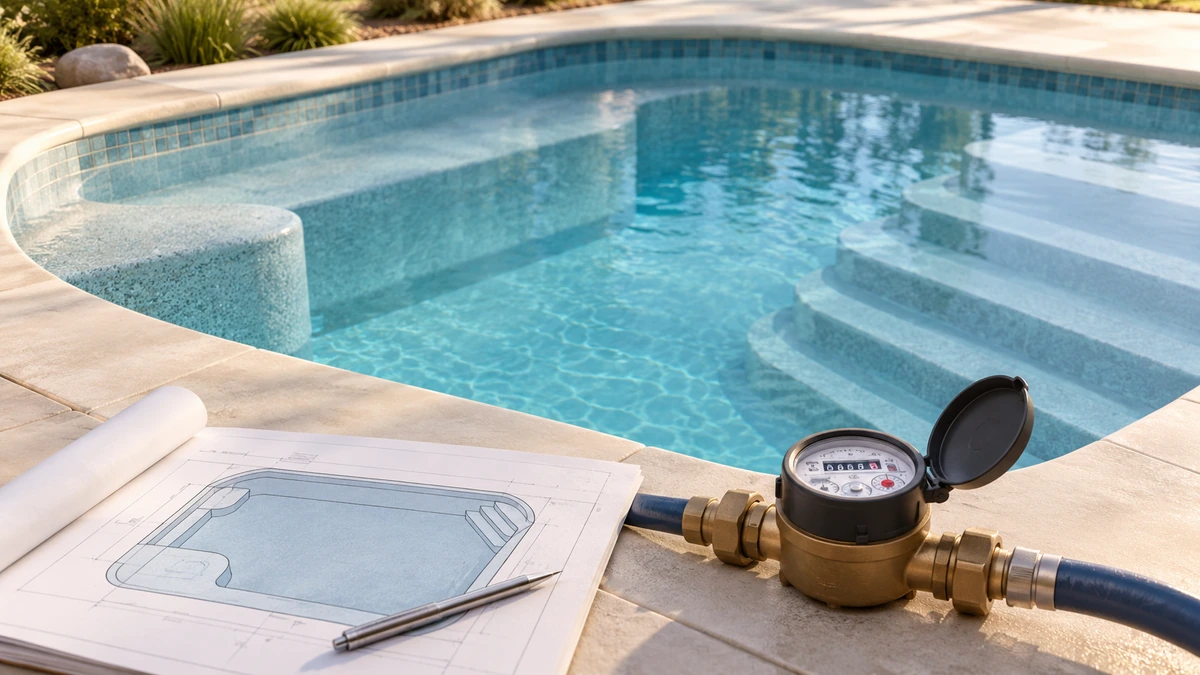
Compare the estimate with builder records if they describe the capacity at your actual waterline. During a metered fill, record readings before and after and account for any other water drawn through the meter. A partial refill measures the water replaced over that interval. To use a fill reading as the full capacity, you need to know the starting water level.
Write down the date, waterline, shape assumptions, and final unit next to your estimate. If you save a volume as My Pool, use that record to review the number after a renovation or a change in operating level. For dosing, confirm the measurement against reliable records when possible and follow the product label.
Key takeaways
- Measure the pool at the waterline and keep the units beside the numbers.
- Split changing depths or shapes into sections you can measure separately.
- Record the uncertainty before using the estimate for another calculation.
Frequently asked questions
Sources
Last verified: November 21, 2026 – check the official source.
- 01
U.S. Department of Energy Building America Solution Center
Variable-Speed Pool Pumps: measuring pool volume - 02
National Institute of Standards and Technology
SI Units – Volume
Educational information only. Follow the requirements of the receiving organization, product label, applicable standard, or qualified professional for your situation.