
In this guide
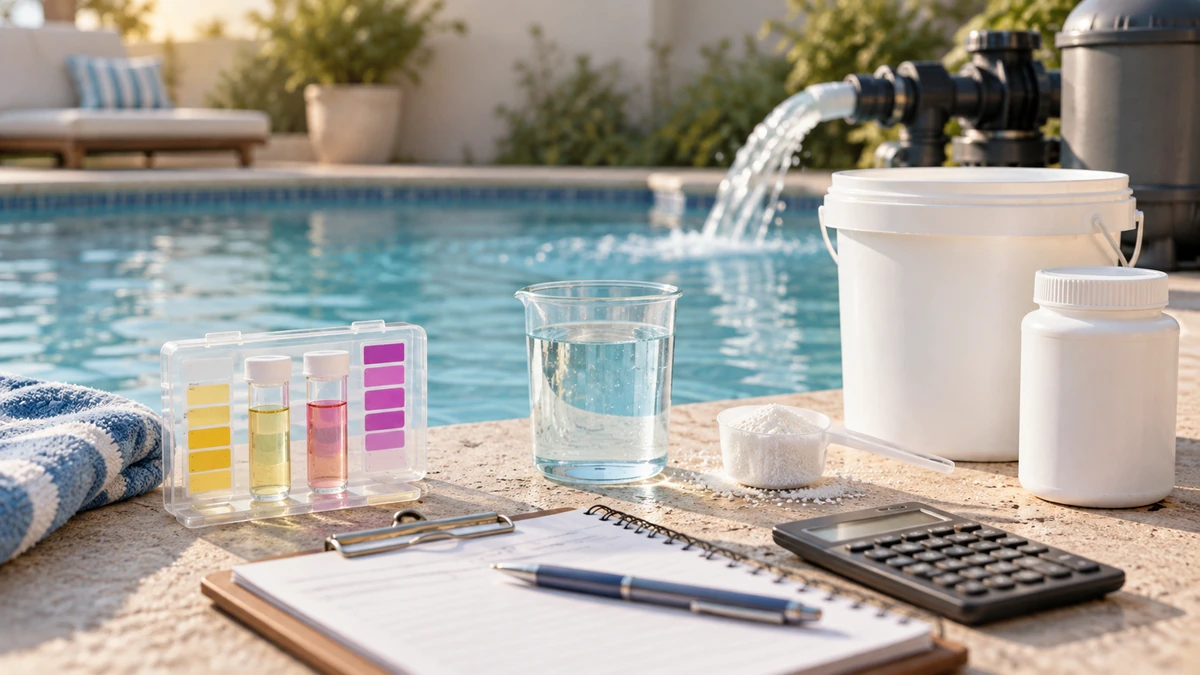
A chlorine calculation starts with a fresh free chlorine reading, the volume of water you are treating, and the product label. Write those down before opening the calculator. That gives you a record to review if a result looks surprising or the next test comes back different from what you expected.
This guide covers routine adjustments for home swimming pools. The Centers for Disease Control and Prevention recommends testing both free chlorine and pH regularly, and its home-pool guidance distinguishes pools using cyanuric acid from pools without it. Follow the product label and the guidance that applies to your pool when choosing a target or deciding when to reopen it.
U.S. Centers for Disease Control and PreventionSteps at a glance
- Record a fresh free chlorine and pH test and confirm your pool volume.
- Check the product label for its formulation and strength and confirm the target for your pool.
- Enter the current and target free chlorine, volume, and product. Compare the result and its units with the label.
- Follow the label for handling and circulation. Retest before making another adjustment.
Read the water test and the product label
Take the sample and read the test within the instructions for your kit. Write down free chlorine and pH separately. Some kits also report total chlorine. Find the result explicitly labeled free chlorine, which is the reading requested by this calculator. When a result is outside your kit’s measuring range or the color is hard to interpret, consult the kit instructions or get another reliable test before using the number.
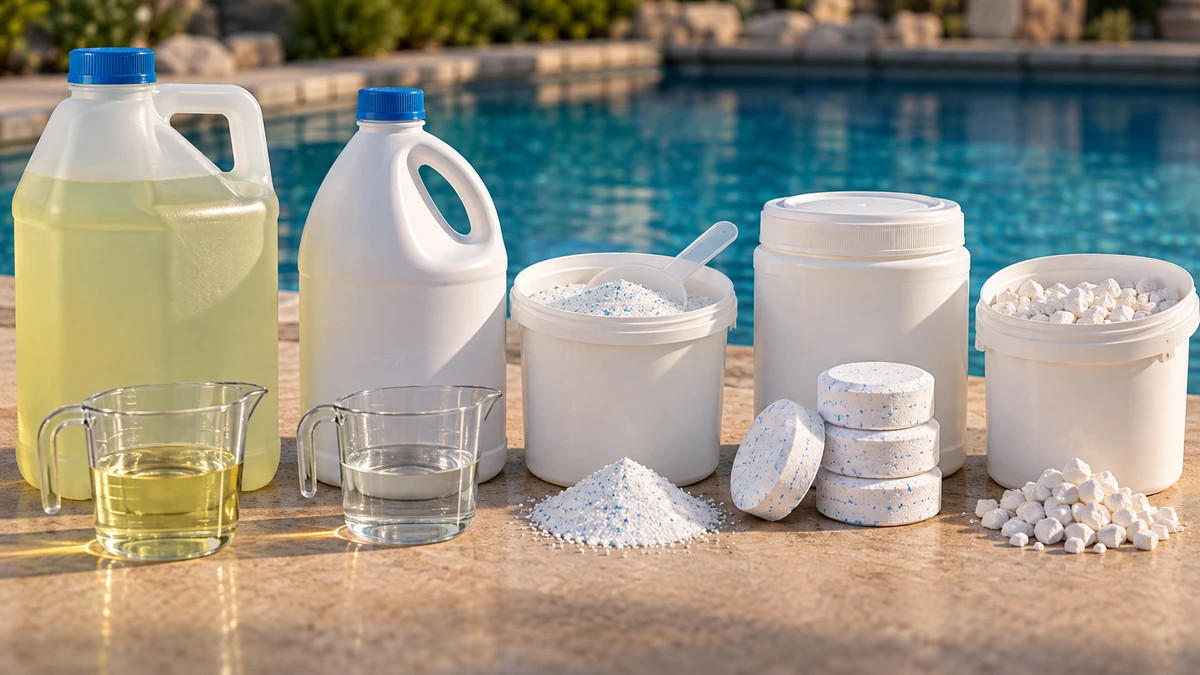
Find the exact name and concentration on the label of the product you are holding. Different formulations sold for the same job may have different ingredients or strengths. A number copied from an old bottle or remembered from a previous batch does not identify the current product. If the calculator does not offer your formulation or the label’s concentration basis is unclear, check the manufacturer’s dosing instructions.
Confirm whether the pool volume is in U.S. gallons or liters. If your estimate came from an earlier fill or a previous owner, check whether it still reflects the pool’s current dimensions and operating level. A wrong unit or volume can change the amount even when the chlorine reading is right.
| Input | Where to check it | Common mix-up |
|---|---|---|
| Pool volume | Metered fill, builder record, or measured estimate | U.S. gallons and liters |
| Current free chlorine | Fresh water test | Free chlorine and total chlorine |
| Target free chlorine | Guidance applicable to your pool | A target and the increase from today’s reading |
| Product strength | Container label and manufacturer directions | Product concentration and amount to add |
Work through the requested change
Imagine a home pool with a current reading of 2 ppm. If the appropriate target for that pool has already been confirmed as 3 ppm, the requested increase is 1 ppm. Enter 2 in the current field and 3 in the target field. Entering 1 as the target would tell the calculator that the current reading is already above it. These numbers are an example of how to read the fields.
Now compare two otherwise identical calculations, one for 10,000 U.S. gallons and one for 20,000 U.S. gallons. With the same product strength and the same requested increase, the calculation uses twice the estimated product amount for twice the water, subject to rounding. This is a way to check whether the inputs make sense before reading the result against the label.
Check the unit on the result. A liquid result may be shown in fluid ounces or milliliters, while a dry result may be shown in ounces by weight or grams. If you are comparing the answer with the label or a measuring container, compare quantities in matching units. Record the estimated amount and the label’s actual instructions separately in your notes.
Handle, circulate, and retest as directed
Read the label before opening the product. Use the specified protective equipment and follow the directions on where and how to add it. Keep pool chemicals separate and never mix them. The CDC’s chemical-safety guidance covers protective equipment, handling, and storage. If the label is damaged or you cannot identify the product, ask the manufacturer how to handle it.
U.S. Centers for Disease Control and PreventionFollow the label’s requirements for circulation and time between addition and swimming. Retest before making another adjustment. If the reading differs substantially from the estimate, check the water test, volume, product, measuring units, and circulation with a pool professional if needed. Use the new reading when reassessing the dose.
Keep a simple log with the date, time, test results, product, and amount added. The log helps you distinguish a repeated test result from a repeated dose. If the water needs attention after a contamination incident or an equipment problem, get guidance suited to that situation before treating it as a routine top-up.
Key takeaways
- Record the free chlorine reading, pH, pool volume, and label details.
- Check that the result uses the unit your measuring equipment supports.
- Follow the label and take a fresh reading before another adjustment.
Frequently asked questions
Sources
Last verified: November 21, 2026 – check the official source.
- 01
U.S. Centers for Disease Control and Prevention
Home Pool and Hot Tub Water Treatment and Testing - 02
U.S. Centers for Disease Control and Prevention
Pool Chemical Safety
Educational information only. Follow the requirements of the receiving organization, product label, applicable standard, or qualified professional for your situation.